There is a video format running on Instagram and TikTok right now that makes absolutely no logical sense — and yet you cannot look away from it.
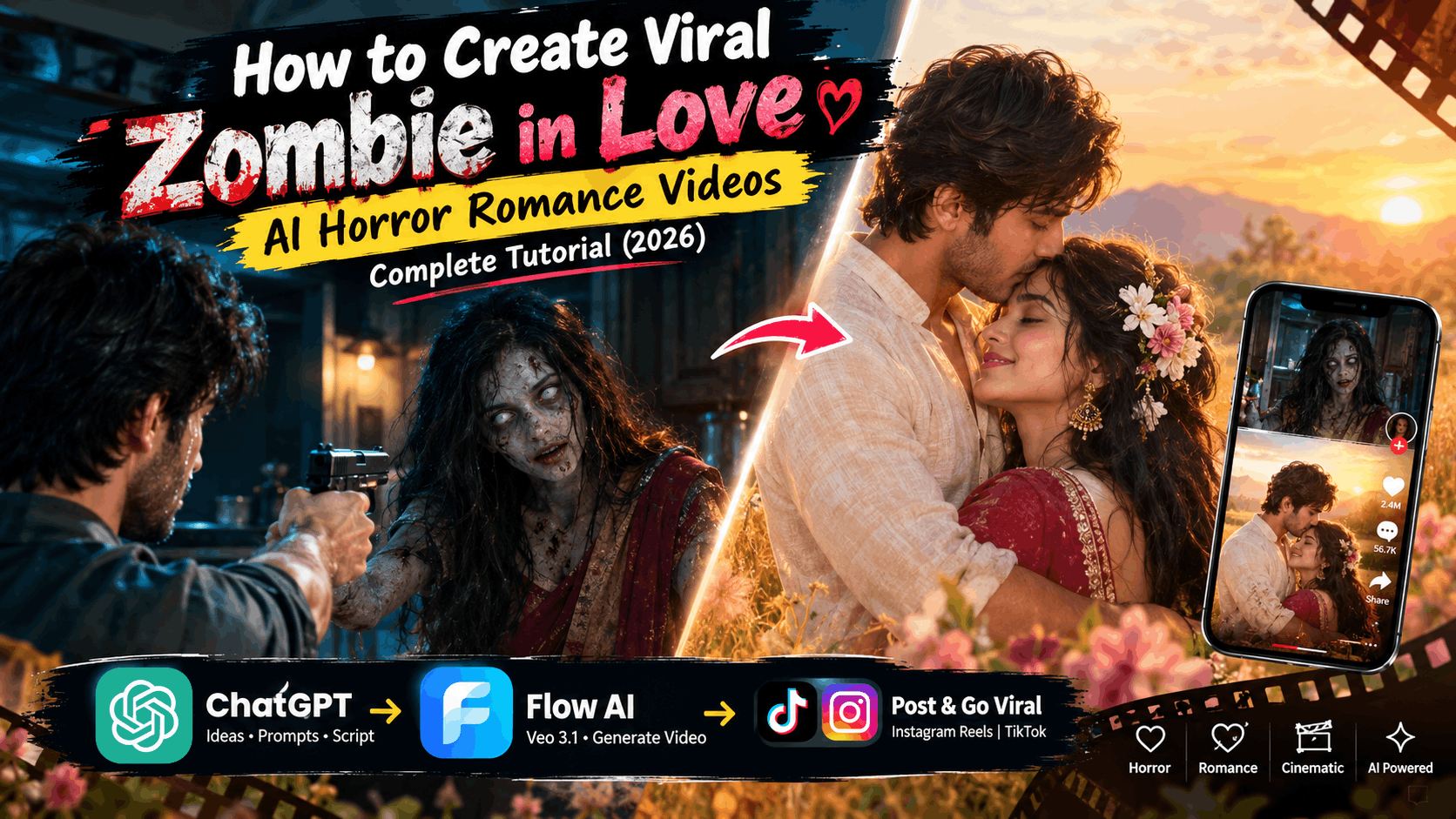
A man standing in a dark kitchen, tears streaming down his face, hand trembling as he points a gun forward. The camera reverses to reveal who he’s pointing it at: a woman. Pale, decaying skin. Milky white eyes. Hair wild and unkempt. Moving toward him with the slow, jerking walk of something no longer entirely human.
And then — he lowers the gun.
He opens his arms.
She lunges into the embrace.
Cut to a golden-hour flashback. The same man. A different version of the same woman — flowers in her hair, warm brown eyes, laughing in a sunlit meadow. Running hand-in-hand through tall grass. Sitting on a hillside at sunset as he kisses her head.
The message, delivered without a single word of dialogue: he knows what she has become. He loves her anyway.
This is the Zombie/Possessed Woman in Love AI video trend — one of the most emotionally ambitious, most cinematically daring, and most viscerally compelling short-form AI video formats operating on social media in 2026. It pairs the visual language of horror cinema with the emotional language of romantic tragedy, and the result is something that hits viewers in a completely unexpected place.
In this complete tutorial, you’ll learn exactly how to create this format using Claude or ChatGPT for creative development and Flow AI’s Veo 3.1 model for cinematic video generation — including the two complete production-ready prompts that generate both the horror embrace scene and the golden-hour flashback.
Why This Format Is Going Viral Everywhere
The “zombie in love” format is not just trending — it’s generating the kind of passionate, invested comments that most content creators never see. People are writing paragraphs. They’re tagging partners. They’re asking “who made this and why am I crying?” Understanding why this specific content combination hits so hard is what allows you to replicate and expand it effectively.
Horror and romance have always been the same story at their core. The greatest horror films have always been love stories in disguise. Beauty and the Beast is a monster romance. The Shape of Water is a monster romance. Countless zombie narratives — 28 Days Later, Warm Bodies, The Returned — are ultimately about love persisting in the face of transformation, loss, and the unknown. The “zombie in love” format taps directly into this deep narrative archetype that human beings have been telling each other for centuries.
The premise triggers an immediate emotional question. The moment a viewer sees a man raising a gun at a possessed woman, their brain asks: “Will he do it? Does he know her?” That question is the most powerful hook in storytelling — a moral dilemma with no clean answer. Should he shoot? Should he embrace? The unresolvable tension keeps viewers locked in.
The flashback structure is a masterstroke of emotional manipulation. Showing the horror scene first, then cutting to a tender golden-hour memory of the couple together, retroactively transforms everything the viewer just watched. The possessed woman is no longer a monster — she’s someone’s love. The man with the gun is no longer a survivor — he’s someone choosing between safety and devotion. The flashback doesn’t just add information; it recontextualizes everything.
The South Asian cultural specific resonates globally. The specific visual choices in the reference prompts — the traditional sari on the possessed woman, the gold jewelry and flowers in the flashback, the rustic kitchen setting — embed the story in a South Asian cultural context that simultaneously reaches the enormous South Asian global audience while feeling exotic and cinematic to international viewers.
The format rewards multiple watches. On first watch, viewers react to the horror. On second watch, they notice the emotional details — the specific way he opens his arms, the flowers in her hair in the flashback. On third watch, they’re looking for clues, connections, the story between the scenes. High replay rate is one of the most powerful algorithm signals on Instagram and TikTok.
The comment section becomes a storytelling community. Viewers don’t just watch — they write the story themselves. “He can’t let her go even now.” “She was there before the possession, somewhere.” “The way he already knew.” The format invites interpretation and collaborative storytelling, which generates comment engagement that drives algorithmic distribution far beyond the initial view count.
What You Need for This Workflow
Two tools. The same two that power every format in this guide:
- Narrative Development, Scene Writing & Prompt Engineering — Claude or ChatGPT
- Video Animation & Cinematic Generation — Flow AI (Veo 3.1 model)
No film set. No special effects makeup. No actors. No camera equipment. Everything is generated from prompts — and at Veo 3.1 quality, the cinematic output is dark enough, emotional enough, and visually sophisticated enough to compete with short-film quality content in the same feed.
Step 1: Narrative Development & Prompt Engineering (Claude or ChatGPT)
The “zombie in love” format is more narratively complex than most AI video formats. It has characters with history. It has a specific emotional arc. It requires tonal control — the horror must feel genuinely threatening for the embrace to feel genuinely moving. This is where Claude or ChatGPT become essential creative partners, not just prompt machines.
The Three Elements That Every Zombie in Love Video Needs
Element 1 — Earned Terror The horror/possessed character must be genuinely frightening in the first scene. If the possessed woman looks mildly unwell rather than truly threatening, the man’s courage in lowering his weapon has no emotional weight. The horror must feel real for the love to feel heroic.
Ask Claude or ChatGPT to help you develop the specific visual details that make the possessed/monster character feel genuinely threatening — not cartoonish, not cheap — while still retaining enough humanity that the flashback transformation is believable.
Element 2 — Recognizable Love The flashback must show a relationship that the viewer instantly believes in. The couple in the golden-hour scene must feel genuinely in love — not posed, not promotional, but warm, specific, real. Details matter: flowers in her hair, the specific way he kisses her head, the location and light.
Ask Claude or ChatGPT to develop flashback scenes that capture specific intimate details of a relationship — the small gestures that feel true rather than generic.
Element 3 — The Decisive Moment The emotional peak of the format is the moment he lowers the gun and opens his arms. This decision — choosing love over survival — must be clear, deliberate, and emotionally legible in the visual language. The body language, the expression, the timing of the gesture must communicate the internal surrender that the scene represents.
How to Use Claude or ChatGPT for This Format
For developing new stories:
“I want to create a ‘zombie in love’ AI video in the style of the current trend — a two-part video where Scene 1 shows a man confronting a possessed/zombie version of someone he loves, then surrendering to love by embracing her, and Scene 2 is a golden-hour flashback showing their relationship before the transformation. I need your help developing:
- A cultural/regional setting for my version (I want to explore [South Asian / East Asian / West African / Latin American / Middle Eastern / European] context)
- The specific horror visual design for the possessed character — what makes her terrifying, what transformation detail reveals her humanity is still there beneath the possession
- The specific romantic detail in the flashback that retroactively makes the horror scene devastating
- The exact decisive emotional moment — what gesture or expression communicates his choice
- Convert all of this into two complete Flow AI video generation prompts — one for the horror/embrace scene and one for the golden flashback”
For developing variations on the format:
“Give me 10 different cultural/story variations of the ‘zombie in love’ format — each with a different cultural setting, a different type of supernatural transformation (possession, zombie, ghost, curse, monster, etc.), and a different relationship dynamic between the two characters. For each variation, describe what makes the horror scene distinct and what makes the romantic flashback specifically heartbreaking. Then rank them by estimated viral potential.”
The Complete Two-Part Prompt — The Exact Formula
These are the two production-ready prompts that generate the complete “zombie in love” video. Use them as-is or as templates for your own variations:
PROMPT 1: The Horror Standoff & Embrace
Cinematic horror drama, close-up shot of a young South Asian man
with wavy black hair crying uncontrollably, tears streaming down
his cheeks, trembling as he points a black handgun forward in a
dimly lit, rustic kitchen with vintage wooden cabinets.

Reverse medium shot reveals a terrifying possessed woman in a worn
earthy sari, pale decayed skin, blank milky-white eyes, and unkempt
hair stalking toward him.

In emotional surrender, the man lowers his weapon and slowly opens
his arms wide. The demonic woman lets out a guttural shriek and
lunges forward into the embrace in motion blur.

Atmospheric floating dust, moody low-key cinematic lighting,
8K resolution, raw emotional tension.
PROMPT 2: The Golden Hour Flashback
Seamless cinematic flashback transition to a breathtaking
golden-hour meadow at sunset. Warm, glowing sunlight illuminating
a happy young South Asian couple lying intimately in tall grass,
looking into each other's eyes with gentle smiles; the woman has
flowers in her hair and wears traditional gold jewelry.

Wide tracking shot of them running hand-in-hand through sunlit
wild grass, followed by an emotional silhouette shot sitting
together on a high grassy hill overlooking a vast mountain valley
as the man tenderly kisses her head.

Warm golden flare, 35mm film aesthetic, shallow depth of field,
romantic nostalgia.
The Anatomy of Each Prompt — Why Every Detail Matters
PROMPT 1 — Breaking Down the Horror Scene
“Close-up shot of a young South Asian man with wavy black hair crying uncontrollably” The opening frame establishes the emotional state before revealing the threat. Showing his tears first means the viewer understands immediately that this is not a straightforward confrontation — this man is not cold or strategic. He is breaking. This emotional vulnerability is what makes the horror hit harder when it’s revealed.
“Dimly lit, rustic kitchen with vintage wooden cabinets” The kitchen setting is brilliant — it’s the most domestic, most intimate room in any home. The possession has entered the safest space. “Vintage wooden cabinets” adds cultural and temporal texture that grounds the scene in a specific world.
“Reverse medium shot reveals a terrifying possessed woman” The camera reverse is a classic horror technique — show the reaction before the threat, then reveal the threat. By the time we see the possessed woman, we’ve already absorbed the man’s terror, which amplifies how threatening she looks.
“Worn earthy sari, pale decayed skin, blank milky-white eyes, unkempt hair” Every detail is specific and serves a dual purpose: “worn earthy sari” establishes she was an ordinary person (not always possessed), “pale decayed skin” signals the supernatural transformation, “blank milky-white eyes” is the classic horror possession visual, and “unkempt hair” is the disruption of care and appearance that was once maintained.
“In emotional surrender, the man lowers his weapon and slowly opens his arms wide” The word “surrender” is doing enormous emotional work here. He’s not forgiving her. He’s not trying to cure her. He is surrendering to love, accepting the risk, choosing vulnerability over safety.
“The demonic woman lets out a guttural shriek and lunges forward into the embrace in motion blur” This is the most technically sophisticated moment in the prompt. The shriek suggests the possession is still in control — she is not cured, she has not returned. And yet she lunges toward him rather than away. The motion blur makes the moment cinematic and prevents the AI from needing to render a perfect embrace — the blur is both aesthetically appropriate and technically functional.
PROMPT 2 — Breaking Down the Flashback Scene
“Seamless cinematic flashback transition” The word “seamless” tells the AI to create a smooth visual transition between the horror kitchen and the golden meadow — not a hard cut, but a cinematic transition that feels deliberate and emotional.
“Breathtaking golden-hour meadow at sunset” The maximum contrast with the dark kitchen. The flashback doesn’t just show happier times — it shows the most luminous, warmest, most cinematically beautiful version of their relationship. The contrast with the horror scene is part of the emotional design.
“The woman has flowers in her hair and wears traditional gold jewelry” The flowers in the hair directly contrast with the unkempt hair of the possessed version. The gold jewelry contrasts with the decay. These visual echoes connect the two scenes and make the horror version more heartbreaking in retrospect.
“Wide tracking shot of them running hand-in-hand through sunlit wild grass” Running toward each other / with each other is one of cinema’s oldest emotional shorthand gestures. It communicates joy, freedom, and choice — all three of which are gone in the possession scene.
“The man tenderly kisses her head” This specific gesture — a head kiss rather than a lip kiss — communicates a specific type of love: protective, gentle, reverent. It retroactively explains why he opens his arms in the horror scene. This is the love he’s choosing to honor.
“Warm golden flare, 35mm film aesthetic, shallow depth of field, romantic nostalgia” The technical finishing instructions establish the visual register: warm (opposite of the horror scene’s cold), film-quality (elevated aesthetic), shallow depth of field (both characters in their own intimate world), and “romantic nostalgia” tells the AI the entire emotional register of the flashback.
10 Cultural Variations — Your Complete Content Series
The South Asian setting is powerful, but the “zombie in love” format is infinitely adaptable to different cultural contexts, each one bringing its own visual language, costume tradition, and emotional texture:
Variation 1 — East Asian Ghost Romance
SCENE 1: A young East Asian man in a modern apartment,
frantically drawing protection talismans on the doorframe as
a female ghost in a tattered white han-fu dress with long black
hair covering her pale face drifts toward him. He stops.
He turns. He faces her and kneels.

SCENE 2: Flashback — cherry blossom forest in spring.
The same couple walking under falling petals, her in a vibrant
red qipao, him in simple linen, reaching up to catch a blossom
and place it in her hair. Soft afternoon light, film grain.
Variation 2 — West African Spirit Possession
SCENE 1: A young West African man in a dusty village compound,
holding a ritual object as a woman in a torn bright kente cloth,
white face paint, and hollow dark eyes moves toward him in
trance-like steps. He sets down the ritual object and extends
both hands palm-up — an offering, not a defense.

SCENE 2: Flashback — harvest festival. The same woman in
full ceremonial dress, laughing and dancing, the man clapping
and watching her with complete adoration. Golden firelight,
drums, warmth.
Variation 3 — Latin American La Llorona
SCENE 1: A young Mexican man stands at the edge of a misty
river at night as La Llorona — a weeping woman in a white
dress, hollow eyes, reaching arms — rises from the water and
approaches. He stays. He doesn't run. He reaches forward.

SCENE 2: Flashback — Día de los Muertos festival.
The same woman in vibrant face paint and marigold dress,
laughing beside him among the candles and offerings.
Warm orange candlelight, celebration, joy.
Variation 4 — Middle Eastern Djinn Possession
SCENE 1: A young Arab man in a traditional thobe holds prayer
beads, trembling, as a possessed woman in a dark abaya with
ember-glowing eyes and smoke rising from her hands moves
toward him. He closes his eyes, drops the prayer beads,
and steps toward her.

SCENE 2: Flashback — a roof terrace at sunset in an ancient
medina, the same couple watching the call to prayer together,
her hand in his, city glowing gold below them. The specific
peace of a moment that will not come again.
Variation 5 — Japanese Onryō (Vengeful Spirit)
SCENE 1: A young Japanese man in a dimly lit traditional room,
candles guttering as an onryō — pale woman in white funeral
kimono, long black hair wet, moving with inhuman speed —
stops before him. He bows deeply. An act of recognition,
not surrender.

SCENE 2: Flashback — summer matsuri festival.
Paper lanterns, the woman in a delicate yukata, the man
winning a goldfish for her. Her laughing expression.
The lanterns floating on a dark river.
Variation 6 — European Gothic Castle
SCENE 1: A young man in 19th century clothing holds a
silver cross as a female vampire in a Victorian dress,
pale and sharp-featured, red eyes glowing, descends the
stone staircase toward him. He lowers the cross.
He extends his hand.

SCENE 2: Flashback — daylight in the castle garden.
The same woman, alive and warm, tending roses in morning
sunlight, turning to smile at him with completely human joy.
Soft Edwardian afternoon light.
Variation 7 — Korean Mudang (Shaman) Possession
SCENE 1: A young Korean man stands in a ritual space,
surrounded by paper prayers, as a possessed mudang in
ceremonial dress with white-painted face and rolling eyes
performs her trance toward him. He bows until his forehead
touches the floor — the deepest possible gesture of reverence.

SCENE 2: Flashback — a mountain temple at dawn.
The same couple sitting together watching the mist clear
from the valley below, her head on his shoulder, complete
silence and complete peace.
Variation 8 — South American Curandera Curse
SCENE 1: A young Peruvian man holds healing herbs as a woman
in traditional Andean clothing, cursed eyes dark as obsidian,
approaches across a highland meadow in the fog. He scatters
the herbs on the ground between them — an offering —
and opens his arms.

SCENE 2: Flashback — Andean market day. The same woman
selling bright textiles and laughing with neighbors,
the man arriving with flowers. Mountain light.
The specific ordinary beauty of a life.
Variation 9 — Filipino Aswang Horror
SCENE 1: A young Filipino man stands in a nipa hut,
holding a garlic wreath as an aswang — a woman with elongated
tongue, dark wings, and hollow eyes — lands before him.
He sets down the garlic. He speaks her name.

SCENE 2: Flashback — provincial fiesta.
The same woman in a bright barong, dancing in the plaza
under fairy lights, the man watching her from the edge
of the crowd with a smile he can't contain.
Variation 10 — Modern Urban Zombie
SCENE 1: A man barricaded in an apartment, supply cache
behind him, as a zombified woman in torn everyday clothes,
bite marks on her neck, slowly approaches. He lowers his
guard, moves past his barrier, and sits on the floor
in front of her.

SCENE 2: Flashback — the same apartment, before.
Both of them cooking together in the kitchen, a mundane,
perfect ordinary Tuesday evening. The specific intimacy
of a shared domestic life.
Step 2: Video Animation (Flow AI — Veo 3.1 Model)
The “zombie in love” format makes specific demands on AI video generation that many models struggle with but Veo 3.1 handles exceptionally well.
Why Flow AI Is Right for This Format
Horror visual rendering. The possessed woman’s specific visual elements — decayed pale skin, milky-white eyes, unkempt hair, the worn sari — require the model to render detailed, realistic horror makeup and physical transformation without falling into cartoonish territory. Veo 3.1’s photorealistic rendering keeps the horror grounded in physical reality, which is what makes it genuinely unsettling rather than merely visually loud.
Extreme lighting contrast between scenes. The two scenes require completely opposite lighting approaches: moody low-key cinematic darkness for the horror kitchen, and warm golden-hour glow for the flashback meadow. Veo 3.1 handles lighting design with enough sophistication to produce both extremes with quality, and the transition between them with cinematic intentionality.
Motion blur for the embrace moment. The “guttural shriek and lunges forward into the embrace in motion blur” instruction requires the model to generate deliberate motion blur — not as an artifact, but as a cinematographic choice. Veo 3.1 can interpret this as a creative instruction and render the embrace in that specific visual style.
Film aesthetic for the flashback. The “35mm film aesthetic” instruction for the flashback requires the model to apply a specific visual quality — grain, warmth, slight halation around bright areas, color rendering characteristic of analog film stock. This is a sophisticated instruction that Veo 3.1 interprets effectively.
Emotional facial expression and body language. The entire story of both scenes is carried in faces and bodies — his tears, her hollow eyes, the specific way he opens his arms, the way she kisses him in the flashback. Veo 3.1’s character expression and body language rendering is sophisticated enough to carry this emotional weight.
Complete Flow AI Workflow
For Prompt 1 (Horror Embrace):
- Open flow.google.com, text-to-video tool
- Set format: 9:16 vertical, duration: 8-12 seconds
- Paste Prompt 1 exactly
- Generate 3-4 variations
- Evaluate for: Is the possessed woman genuinely unsettling? Does the embrace moment have emotional weight? Is the lighting sufficiently dark and moody? Is the man’s emotional state (tears, trembling) legible?
- Select best variation, download
For Prompt 2 (Golden Hour Flashback):
- Same tool, same format settings
- Paste Prompt 2 exactly
- Generate 3-4 variations
- Evaluate for: Is the golden-hour lighting warm and cinematically beautiful? Do the couple appear genuinely intimate and in love? Are the costume details (flowers, jewelry) visible? Does it feel like a different temporal register from Scene 1?
- Select best variation, download
Assembly (Optional — for a complete video): If you want to present both scenes as one continuous video, assemble them in CapCut or any basic editing tool: Scene 1 (8-12 seconds) → brief black or white flash transition → Scene 2 (8-12 seconds). Total video: 16-24 seconds, ideal for Instagram Reels and TikTok.
Refinement Tips for Each Scene
If Prompt 1 possessed woman looks too cartoonish: Add “practical special effects quality makeup — the horror is grounded in photorealistic physical detail, not digital artifice. Skin texture shows realistic decay without exaggeration.”
If Prompt 1 embrace doesn’t read emotionally: Add “the man’s expression during the embrace is simultaneously terrified and completely at peace — the specific expression of someone who has made an irreversible choice and found clarity in it.”
If Prompt 2 looks too posed or stock-photo: Add “candid, unposed, natural movement — the couple moves as if unaware of the camera, their intimacy existing entirely for each other and not for an audience.”
If the flashback doesn’t feel like a different time: Add “the entire color palette is 15% warmer than natural, the contrast softer, the details slightly softened as if remembered rather than observed — the visual quality of a cherished memory.”
MASTER PROMPT: Zombie / Possessed Love AI Videos
Complete, production-ready Master Prompt for Claude or ChatGPT:
ROLE: You are an expert cinematic AI video narrative director
and prompt engineer specializing in the "zombie in love" or
"possessed love" horror-romance short film format trending on
Instagram and TikTok. You understand the specific emotional
architecture that makes this format go viral — the horror
that must be genuine, the love that must be specific,
and the decisive moment that makes viewers cry.

TASK: Create a complete two-scene production package for one
"zombie/possessed love" AI video.

CULTURAL CONTEXT: [South Asian / East Asian / West African /
Latin American / Middle Eastern / European / Other]

SUPERNATURAL ELEMENT: [Possession / Zombie / Ghost /
Djinn / Vampire / Onryō / Aswang / Curse / Other]

RELATIONSHIP: [Lovers / Spouses / Childhood sweethearts /
Newly engaged / Long-separated / Other]

STEP 1 — STORY FOUNDATION:
Develop the micro-narrative:
A. Who were they before? (2-sentence relationship history)
B. What caused the transformation? (1-sentence origin)
C. What is his emotional state in the horror scene —
   specifically what is he grieving?
D. What is the ONE specific detail in the flashback that
   retroactively makes the horror scene devastating?
E. What does his decisive gesture communicate — what choice
   is he making by lowering his weapon?

STEP 2 — CHARACTER DESIGNS:
For the POSSESSED/HORROR version of the woman:
- Skin: specific transformation detail
- Eyes: specific horror visual
- Clothing: the cultural garment, now worn/damaged
- Movement style: how does the supernatural move?
- The ONE detail that reveals her humanity is still in there

For the LIVING/FLASHBACK version:
- The specific costume and cultural details
- The ONE physical detail (flowers, jewelry, specific gesture)
  that creates a visual echo with the horror version
- Her expression and energy in the happiest moment

STEP 3 — SCENE 1 (HORROR & EMBRACE):
Complete Flow AI prompt including:
- Camera specification (close-up → reverse reveal)
- Setting design (room, lighting, specific objects)
- His emotional state in precise visual terms
- Her horror appearance in precise visual detail
- The approach and the decisive surrender moment
- The embrace — how it happens, the motion quality
- Atmospheric details (dust, lighting, shadow)
- Technical specs (8K, cinematic, specific lighting style)

STEP 4 — SCENE 2 (GOLDEN HOUR FLASHBACK):
Complete Flow AI prompt including:
- Transition description (how Scene 1 connects to Scene 2)
- Location and specific setting details
- The specific tender moment that is the emotional heart
- The visual echo detail that connects to Scene 1
- Camera movement sequence (2-3 shots within the scene)
- Time of day, lighting quality, color temperature
- Film aesthetic specification
- Technical specs

STEP 5 — ASSEMBLY GUIDE:
How to combine both scenes into one complete video:
- Scene 1 duration recommendation
- Transition type and duration
- Scene 2 duration recommendation
- Total video length
- Any music/audio recommendations

STEP 6 — 5 ADDITIONAL VARIATIONS:
Five more story concepts using different cultural contexts,
each with: cultural setting, supernatural element,
decisive gesture, and the specific devastating detail
that makes the flashback heartbreaking.

STEP 7 — PLATFORM METADATA:
- 3 caption options (wordless, or minimal — the video
  tells its own story; caption adds emotional punctuation)
- 3 title/description options
- 15 hashtags (horror romance + AI video + culture-specific)
- Thumbnail concept (which exact frame from Scene 1, why)

OUTPUT: Organized clearly by Steps 1-7.
The Emotional Architecture — Why the Format Works Every Time
The “zombie in love” format has a specific three-beat emotional structure that delivers the same impact regardless of cultural context or supernatural element. Understanding this structure lets you build variations that hit as hard as the original:
Beat 1 — Earned Terror (Scene 1, first half) The horror must be real. If the possessed character looks mildly threatening, the man’s emotional decision has no weight. The viewer must genuinely feel the danger to understand the courage it takes to lower the weapon. In prompts, this means spending significant descriptive detail on the specific horror elements — the milky eyes, the decayed skin, the inhuman movement. Don’t soften the horror.
Beat 2 — The Decisive Surrender (Scene 1, second half) The moment he lowers his weapon and opens his arms is the pivot of the entire format. It must be clear, deliberate, and visible. The body language must communicate the internal decision: not naivety (he knows she is dangerous), not resignation (he is not giving up), but a specific kind of courage — the choice to love what has become unlovable. In prompts, this means specifying the gesture precisely: “slowly lowers weapon, pauses, then opens arms wide — the deliberate quality of an irreversible decision.”
Beat 3 — The Devastating Context (Scene 2) The flashback retroactively transforms everything the viewer just watched. The golden-hour scene must contain one specific visual echo of the horror scene — a detail that appears in both versions — so the viewer’s mind makes the connection and the full weight of the loss lands. In the reference prompts, this echo is the woman herself — the flowers in her hair are the contrast to the unkempt possession hair, the gold jewelry contrasts with the decay. The echo must be visible without being labored.
The Formula: Horror with emotional stakes + Love that explains the horror + Visual echo that connects them = Emotional devastation that drives sharing
Click Here: How to Create Viral Ceiling Fan Outfit Change AI Videos
Platform Strategy
Instagram Reels — Primary Home The “zombie in love” format was made for Instagram’s Reels environment. The emotional depth rewards the slightly longer attention span Instagram’s audience brings compared to TikTok’s fastest-scroll mode. The format also generates the highest-value Instagram behaviors: saves (people save to rewatch and process), profile visits (people go looking for more from whoever made this), and comment engagement (long, thoughtful, emotionally invested comments).
Post Scene 1 and Scene 2 as one continuous Reel with the transition intact. Duration of 20-25 seconds is ideal — long enough for both emotional beats to land, short enough to replay immediately.
TikTok — Horror Romance Community Discovery TikTok has an active and passionate horror romance community — the same audience that drove Warm Bodies, the Haunting of Hill House, and romantic horror fiction. A “zombie in love” AI video in this format will find this community through the algorithm. Use hashtags that reach both the horror community (#horror #horrortok) and the romance/crying community (#romancetok #cryingovercharacters).
YouTube Shorts — For Cinematics-Focused Discovery YouTube’s algorithm specifically promotes content that viewers rewatch, and the “zombie in love” format with its emotional complexity consistently generates multiple rewatches. Post both scenes as one 20-25 second Short. The YouTube audience for short cinematic/emotional content is substantial and underserved compared to TikTok.
Caption Strategy
This format is unique because the video often works best with minimal or no caption — the story is complete without words. But the right caption amplifies the emotional impact enormously:
The Wordless Caption (Most Powerful): “❤️🩹” — nothing else. The video says everything. “🕯️” — just a candle emoji. Let the video carry it.
The Story Invitation: “He stayed 🥀” “He already knew. He went anyway. 🕯️” “Some people you don’t leave. Not even then. ❤️🩹”
The Mirror Caption (Makes People Tag): “Tag someone who would stay 🖤” “The love that doesn’t leave. Tag them. ❤️🩹”
The Narrative Hint: “She wasn’t always this. He remembers. 🕯️” “The love that makes you lower your gun 🥀” “Before. And after. He chose both. ❤️🩹”
The Rule: Never explain the video. Never describe what happens. The caption adds a single emotional note that the viewer hears as they watch — it does not narrate, it resonates.
Hashtag Strategy
Horror Romance Tags: #HorrorRomance #DarkRomance #ZombieInLove #PossessedLove #HorrorLove #MonsterRomance #DarkLove
AI Video Tags: #AIVideo #FlowAI #AIShortFilm #AICreator #GeneratedVideo #CinematicAI
Emotion/Viral Tags: #Crying #Emotional #ShortFilm #MiniFilm #Heartbreak #LoveStory
Niche Community Tags: #HorrorTok #RomanceTok #CinematicReels #FilmEdit #ViralReels
Monetization Pathways
Paid Story Commissions Once your “zombie in love” videos establish your channel’s capability for cinematic emotional storytelling, you can offer commissioned personalized versions — couples who want their AI “love story” told in this format, brands who want cinematic short film content for their campaigns. The market for premium AI short film content is growing rapidly.
Patreon / Subscription for Exclusive Stories The “zombie in love” format naturally serializes. What happened before the possession? What happens after the embrace? Subscribers on Patreon could access extended versions, additional scenes, different cultural chapters. Horror romance audiences are among the most loyal and highest-converting subscription audiences on the internet.
YouTube Cinematic Long-Form Extend the format into 3-5 minute “mini films” for the YouTube main feed — multiple scenes, more narrative context, full emotional arc. AI-generated cinematic short films in the horror romance genre have a growing YouTube audience and strong AdSense CPMs from entertainment advertisers.
Film/Animation Festival Submissions AI-generated cinematic short films are increasingly being accepted into digital film festivals. A technically and emotionally sophisticated “zombie in love” mini-film could be a legitimate film festival submission, adding cultural credibility and industry attention to your work.
Common Mistakes to Avoid
Making the horror character sympathetic too early. If the possessed woman looks sad or confused rather than genuinely threatening in the first seconds of Scene 1, the format collapses. The horror must earn its terror before the love earns its meaning. Don’t let sympathy undercut the scare.
Generic flashback without a specific visual echo. The flashback only works emotionally if it contains a specific detail that viewers can map back onto the horror scene. “Happy couple in a field” without any visual connection to the horror scene delivers sentiment without devastation. Always design one specific echo detail that appears in both scenes.
Moving too fast through the decisive moment. The moment he lowers the gun is the entire emotional payload of Scene 1. If the prompt generates this moment as a quick action rather than a deliberate, sustained gesture, the impact is lost. Specify “slowly, deliberately, taking three seconds of screen time” in your prompt.
Weak or generic cultural details. The cultural specificity is part of the visual power of this format. “A woman in traditional dress” is generic. “A woman in a worn earthy sari with traditional gold nose ring” is specific, visual, and culturally resonant. Always include at least three specific cultural visual details in your prompts.
Using the format for shock value without emotional depth. The “zombie in love” format’s power comes from its emotional sincerity — it takes the horror premise seriously as a vehicle for genuine feeling. Content that uses the horror aesthetics without the emotional depth produces spectacle without resonance. Build the love story in the flashback as carefully as you build the horror in Scene 1.
Frequently Asked Questions
Can I create this format with characters from my own culture? Absolutely — and cultural specificity is one of the format’s greatest strengths. The more specific and accurate your cultural visual details, the more powerfully the content resonates with your target cultural audience. Use Claude or ChatGPT to research accurate costume, jewelry, setting, and cultural visual details for your specific cultural context.
Is it better to post both scenes as one video or separately? One combined video performs best on Instagram and TikTok because the flashback context is what makes Scene 1 emotionally complete. Posting Scene 1 alone creates incomplete impact. The ideal structure is: Scene 1 (8-12 sec) + brief transition + Scene 2 (8-12 sec) = 16-25 second complete Reel.
How do I make the horror and romance feel like they’re about the same person? Design one specific visual echo that appears in both scenes. In the reference prompts, this is the woman herself — but the visual contrast between her horror appearance and her living appearance is the echo. You can also design a specific object (a piece of jewelry, a flower, a domestic item) that appears intact in the flashback and broken or transformed in the horror scene.
Can I create a gender-flipped version (possessed man, woman stays)? Yes, and gender-flipped versions are currently underrepresented in this format — which means they have significant novelty value. The same emotional architecture applies: the unaffected partner choosing love over safety, the flashback revealing what was lost. The woman lowering her weapon and stepping toward a possessed man hits with the same emotional weight.
What music works best for this format? For posting on TikTok with trending audio: instrumental pieces from horror romance films (gothic strings, piano) perform well. For Instagram where original audio is preserved: the ambient audio of the respective scenes (the creak of the kitchen, the wind through the meadow) often works best. Some creators add a single piano note transition between scenes.
Conclusion
The man in the kitchen didn’t have to stay. He didn’t have to lower the gun. He chose to.
That choice — made in a dimly lit kitchen facing something that used to be the person he loved — is the emotional engine of the most powerful short-form content format of 2026. It asks the oldest question in every love story: what is a person without the specific qualities we fell in love with? And it answers with a gesture instead of words.
Claude or ChatGPT gives you the narrative intelligence: the cultural specificity, the precise horror visual design, the specific tender detail that makes the flashback devastating, and the exact prompt language that tells Flow AI what to generate. Flow AI’s Veo 3.1 model gives you the cinematic dark kitchen, the milky-white eyes, the golden meadow, the 35mm film grain, and the motion-blur embrace that makes the whole thing feel like the opening minutes of a film you need to finish.
Both prompts are in this article. Ten cultural variations are in this article. The Master Prompt is in this article.
The story is universal. The craft is specific. And somewhere in a dimly lit kitchen, in every cultural context you can imagine, a man is lowering his weapon and opening his arms.
Go tell that story.