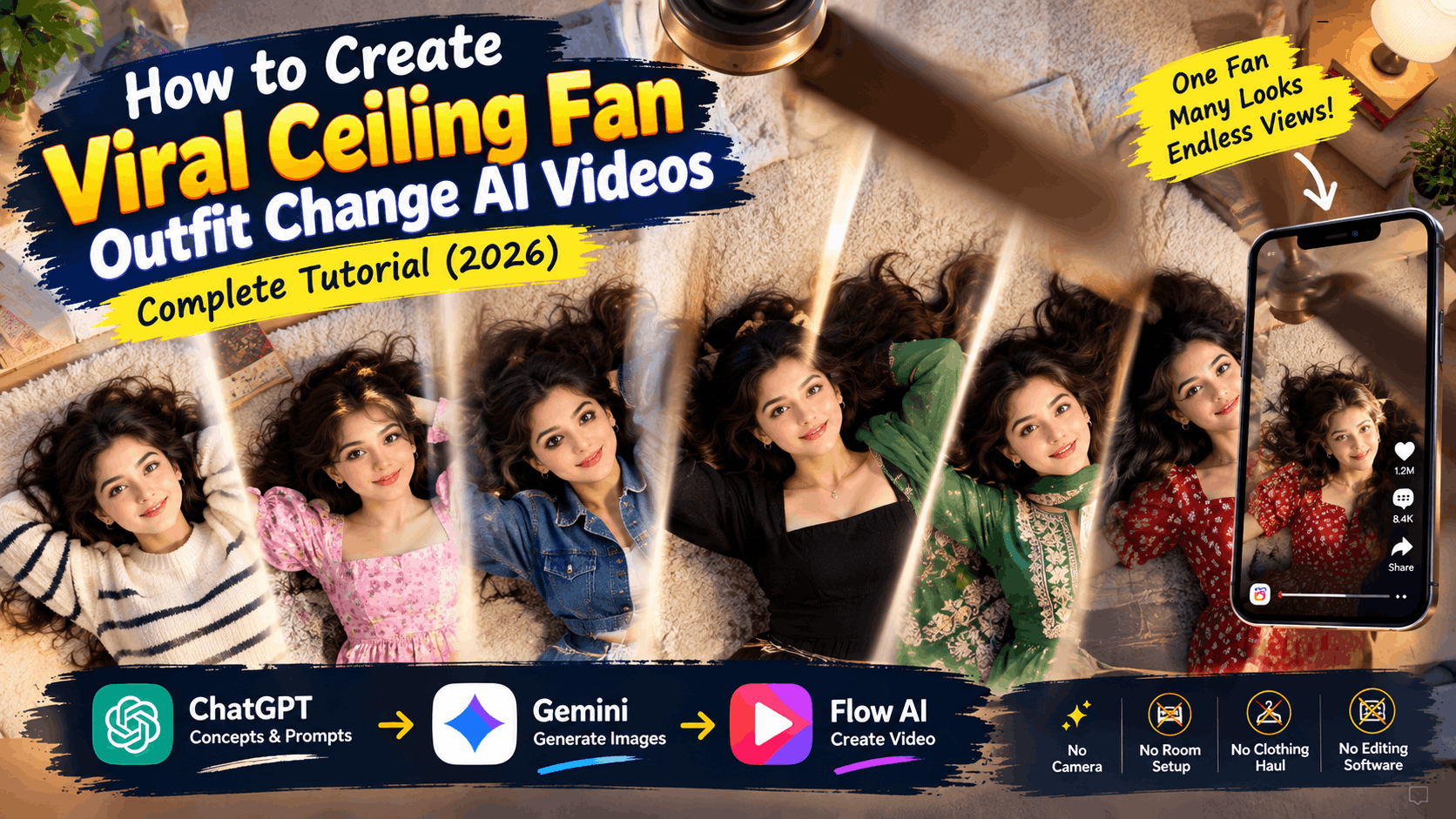
You’ve seen it. You’ve watched it twice. Maybe three times.
A bird’s-eye view from the ceiling. Fan blades spinning slowly overhead. A girl lying on a soft carpet below, looking up at the camera. The fan blade sweeps across the frame — and in that single wipe, she’s in an entirely different outfit. Then again. And again. Six looks, one seamless top-down take, zero cuts that feel jarring. Just the fan blade slicing across the frame, each pass revealing a whole new aesthetic.
This is the Ceiling Fan Outfit Change format — and right now, it is one of the most satisfying, most-replayed, most-shared AI fashion video trends running on Instagram Reels and TikTok. There’s something about the ceiling fan wipe transition that feels almost hypnotic. It’s clean. It’s unexpected. It uses an ordinary household object — a ceiling fan — as a cinematic transition tool in a way that feels genuinely original.
And in 2026, you can create this exact format entirely with AI. No ceiling fan. No bedroom setup. No clothing haul. No filming. Just Claude or ChatGPT for concept development and prompt engineering, and Flow AI’s Veo 3.1 model to generate the cinematic, editorial-quality video from scratch.
This is the complete tutorial — the concept, the creative strategy, the exact prompt, and a full Master Prompt template so you can produce this format for any style, any subject, and any season.
Why the Ceiling Fan Outfit Change Format Hits So Hard
Every viral video format has a specific reason it works — an emotional or psychological trigger that makes people watch, replay, and share. The ceiling fan outfit change format has several, all working simultaneously.
The wipe transition is satisfying on a primal level. Human beings find smooth, clean transitions inherently satisfying. The brain likes completion — it likes the moment when one state ends and another begins with perfect clarity. The fan blade wipe is one of the most visually clean transitions possible. It sweeps across the frame in a single, decisive motion, and the new outfit is revealed as if it was always there. That satisfaction triggers the replay impulse immediately.
The top-down perspective is immediately cinematic and unusual. Most fashion content is filmed at eye level or slightly low. The ceiling-looking-down angle is instantly unusual — it creates a perspective that the viewer doesn’t experience in daily life, which makes the video feel more like art than a standard outfit video. Unusual perspectives trigger the “wait, what am I looking at?” response that keeps viewers engaged.
Multiple outfits in one video removes the “skip” decision. Standard outfit-of-the-day content forces viewers to decide “is this outfit worth watching?” and skip if not. The ceiling fan format removes that decision entirely — each fan blade wipe brings a new outfit before the viewer has time to disengage. Viewers stay for the next wipe even if the current outfit isn’t their style.
The lying-down pose creates intimacy and calm. Unlike most fashion content where the subject is standing, walking, or posing aggressively for camera, the ceiling fan format features the subject lying down, relaxed, looking up. This posture communicates comfort, ease, confidence — and it creates an unusual intimacy with the viewer, who is looking down from above at someone who is calmly present and comfortable in every look.
The format is endlessly repeatable with fresh content. Seasonal outfits. Color palette themes. Decade aesthetics (70s → 80s → 90s → 2000s). Occasion dressing (casual → smart casual → date night → formal). Cultural fashion (traditional → modern → fusion). Every content angle is a new video in the same satisfying format.
The “editorial aesthetic” makes fashion accessible without being intimidating. The soft indoor lighting, the muted carpet, the casual household setting — these elements make the fashion feel achievable and relatable rather than distant and aspirational. Viewers can imagine these outfits in their own bedroom, their own life.
What You Need for This Workflow
Two tools. That’s it.
- Creative Concept Development & Prompt Engineering — Claude or ChatGPT
- Video Animation & Generation — Flow AI (Veo 3.1 model)
No bedroom setup. No ceiling fan. No fashion haul. No camera. No lighting equipment. No editing software. Everything is generated from text prompts, and the output is cinematic enough to compete with real filmed ceiling fan content in the same Instagram feed.
Step 1: Creative Concept & Prompt Engineering (Claude or ChatGPT)
The ceiling fan outfit change video lives or dies by its creative brief. The visual idea is simple — but executing it well requires precise decisions about the subject, the outfit sequence, the setting details, the lighting, and the transition timing. Claude or ChatGPT are exceptional at helping you develop each of these elements with the precision that produces high-quality AI video output.
The Four Creative Decisions That Define Every Ceiling Fan Video
Decision 1 — The Subject Who is lying on the carpet? The most versatile approach is a character description rather than a specific person — a “young woman with [hair type], [skin tone], [physical features]” rather than a named real person. This gives you a consistent, recognizable character across a content series without any identity or consent concerns. Ask Claude or ChatGPT to help you develop a subject description that is specific enough to maintain visual consistency across multiple videos.
Decision 2 — The Outfit Sequence This is the creative heart of the video. The outfit sequence needs:
- A clear theme or narrative arc (e.g., a journey through autumn looks, or transitioning from casual to formal)
- Visual contrast between adjacent outfits (so each fan wipe feels like a real change)
- A satisfying opening and closing look
- 5-7 outfits for the ideal video length (too few feels incomplete, too many feels rushed)
Ask Claude or ChatGPT to develop outfit sequences for any theme you choose. Good themes include:
- Seasonal transition (summer → autumn → winter → spring)
- Color story (all neutrals → one color per wipe)
- Decade tour (60s → 70s → 80s → 90s → 2000s → now)
- Occasion journey (pajamas → casual → work → date night → party → formal)
- Style personality (minimalist → maximalist → boho → preppy → streetwear → elegant)
- Cultural fashion journey (traditional → fusion → contemporary)
Decision 3 — The Setting Details The carpet color, the visible furniture, the soft furnishings, the lighting quality — these details define the “editorial aesthetic” that makes the ceiling fan format look polished rather than generic. The original format uses a “soft muted-blue carpet next to a pink sofa” — this specific color combination creates a pastel, soft, interior-design-curated look that feels deliberately aesthetic.
Ask Claude or ChatGPT to develop setting variations that match your outfit theme:
- Warm neutrals (cream carpet, camel sofa) for autumn/earth-tone outfit sequences
- Cool pastels (light grey carpet, sage sofa) for minimalist/clean aesthetic sequences
- Bold contrast (dark navy carpet, white furniture) for high-fashion/editorial sequences
- Cozy warm (rust carpet, terracotta walls) for winter/holiday outfit sequences
Decision 4 — The Fan and Lighting The ceiling fan is not just a transition tool — it’s a visual element that anchors every frame of the video. Metal fan blades on a white ceiling look clean and modern. Wooden fan blades on a warm ceiling look cozy and editorial. The lighting affects everything: soft indoor light creates warmth and approachability; cooler light creates an editorial magazine quality; warm golden-hour window light creates an intimate, personal feel.
How to Brief Claude or ChatGPT
Here is the exact conversation structure to use:
“I want to create a ceiling fan outfit change video for Instagram Reels — a bird’s-eye view from the ceiling with the fan blade acting as a wipe transition between outfits. I need you to develop the complete creative brief for this video.
Theme I want to explore: [YOUR THEME]
Please provide:
- A complete character description for my subject (hair, skin tone, face, body proportions — specific enough to generate consistently in Flow AI across multiple videos)
- A sequence of 6 outfit descriptions, each one different enough from the last to feel like a real transformation, with a clear style narrative arc
- A setting description — the specific carpet color, furniture, visible room details, and lighting quality that match the editorial aesthetic I want
- A description of the ceiling fan (metal vs wood, blade style, ceiling type) that fits the overall visual
- The character’s pose, expression, and interaction with the camera for each outfit wipe (do they smile? look confident? surprised?)
- Convert all of this into a single complete Flow AI video generation prompt”
The Complete Ceiling Fan Outfit Change Prompt
This is the complete, production-ready prompt used in the reference video. Study it carefully — every detail is intentional, and understanding why each element is specified helps you create effective variations:
Vertical 9:16 bird's-eye view looking down from the ceiling past
slowly spinning metal fan blades. A young girl with long, curly
dark hair lies on a soft muted-blue carpet next to a pink sofa.

On each fan blade wipe transition, her outfit and pose instantly
switch:

starting in a brown knit sweater and jeans,
changing into a white puffer jacket,
then a black and white cardigan dress,
a plaid pleated skirt set,
a red striped cardigan,
and finally a dark maroon sweater with black leggings,

looking directly up at the camera with a warm smile.

Soft indoor lighting, smooth jump-cut transitions,
clean editorial aesthetic.
Why Every Line of This Prompt Works
“Vertical 9:16 bird’s-eye view looking down from the ceiling” This single instruction establishes the entire visual architecture of the video. “Bird’s-eye” and “looking down from the ceiling” tells the AI the exact camera position — directly above, looking straight down. This is the unusual perspective that makes the format visually distinctive.
“Past slowly spinning metal fan blades” “Slowly spinning” is a critical word — a fast-spinning fan would create motion blur that obscures the outfit reveal. “Slowly” gives the fan blades a deliberate, graceful quality that makes each wipe transition satisfying rather than disorienting. “Metal” specifies the blade material, which determines the visual tone (clean, modern, editorial).
“Soft muted-blue carpet next to a pink sofa” This specific color combination — muted blue carpet, pink sofa — creates a pastel, editorial, aesthetically curated background that makes any outfit look intentionally styled. The “muted” qualifier is important: it keeps the background from competing with the outfits.
“On each fan blade wipe transition, her outfit and pose instantly switch” This is the mechanical instruction that tells the AI what the fan blade transition does — it’s not just visual movement, it’s a complete wardrobe change. The word “instantly” tells the AI the change is complete and clean, not gradual.
The outfit sequence — specific descriptions in order Each outfit is described with enough specificity that the AI can render the correct garments, but not so much detail that it becomes confused. “Brown knit sweater and jeans” is the right level of specificity — clear garment type, clear color, no extraneous detail.
The sequence follows a thoughtful style arc:
- Brown knit sweater + jeans → cozy, autumnal, casual starting point
- White puffer jacket → clean, winter, fresh
- Black and white cardigan dress → more dressed-up, graphic
- Plaid pleated skirt set → preppy, academic
- Red striped cardigan → bold, colorful, energetic
- Dark maroon sweater + black leggings → rich, autumnal closing
Notice that the sequence moves through different levels of formality, different color stories, and different aesthetic codes — which means each fan wipe genuinely feels like a different look rather than variations on the same outfit.
“Looking directly up at the camera with a warm smile” This instruction ensures the subject maintains direct camera engagement throughout. Looking straight up (at the overhead camera position) creates the feeling of direct eye contact with the viewer — which is a crucial element of the format’s intimacy and engagement.
“Soft indoor lighting, smooth jump-cut transitions, clean editorial aesthetic” These three closing qualifiers establish the overall visual register: warm (soft), technically clean (smooth transitions), and aesthetically curated (editorial). These words tell the AI this is not raw candid filming — it’s polished, intentional visual content.
10 Complete Outfit Change Video Variations
Here are 10 ready-to-use complete prompts for different ceiling fan outfit change themes. Each is customized for a specific style narrative, setting, and subject:
Variation 1 — Autumn Color Story
Vertical 9:16 bird's-eye view from ceiling past slowly rotating
wooden fan blades. A young woman with straight chestnut brown hair
lies on a warm cream carpet beside a rust-orange armchair.

Fan blade wipes reveal outfit changes:
1. Oversized camel trench coat over cream turtleneck
2. Burgundy chunky knit sweater with dark brown cords
3. Forest green wrap dress with ankle boots
4. Burnt orange blazer with tailored black trousers
5. Brown leather jacket with plaid scarf and dark jeans
6. Rich plum velvet midi dress

Looking up with relaxed confidence each transition.
Warm amber afternoon window light, soft shadows,
cozy editorial aesthetic, 8K quality.
Variation 2 — Minimalist Monochrome Journey
Vertical 9:16 bird's-eye view from high ceiling past sleek
white fan blades. A young woman with a short blunt bob in black
hair lies on a pearl grey carpet beside a white linen sofa.

Fan wipes transition through:
1. All-white linen set — oversized shirt and wide-leg trousers
2. Soft grey cashmere co-ord
3. Cream tailored blazer dress
4. Pale oat ribbed knit sweater with ecru trousers
5. White button-front shirt dress, belted
6. Black turtleneck with tailored white trousers

Neutral expression with quiet confidence, direct upward gaze.
Clean cool indoor light, minimal shadow, high-fashion editorial
aesthetic, fashion magazine quality.
Variation 3 — Decades Tour (60s to 2020s)
Vertical 9:16 bird's-eye view from vintage ceiling fan with
brass blades. A young woman with vintage-set dark hair lies
on a deep teal carpet beside a mustard yellow mid-century sofa.

Each fan blade wipe moves through a decade:
1. 1960s: mod shift dress in geometric black and white
2. 1970s: flared jeans, peasant blouse, platform sandals
3. 1980s: power suit shoulder pads, bold primary colors
4. 1990s: slip dress over white t-shirt, chunky boots
5. 2000s: low-rise jeans, logo tee, butterfly clips
6. 2020s: oversized blazer, straight-leg jeans, barely-there heels

Expression shifts with each decade — wide-eyed wonder (60s) to
cool detachment (90s) to warm confidence (2020s).
Dynamic editorial staging, warm cinematic color grading.
Variation 4 — Traditional to Modern Cultural Fashion
Vertical 9:16 bird's-eye view from ceiling with ornate carved
wooden fan. A young South Asian woman with long black hair adorned
with flowers lies on a rich crimson carpet next to embroidered
gold cushions.

Fan wipes reveal:
1. Deep red silk saree with gold border
2. Embroidered anarkali kurta in emerald green
3. Modern fusion lehenga — structured crop top, full skirt
4. Contemporary sharara set in electric blue
5. Western-fusion — traditional print jacket over modern co-ord
6. Minimalist contemporary outfit with single statement piece

Expression of quiet cultural pride throughout each transition.
Rich warm indoor lighting, jewel-tone color palette,
cinematic editorial quality.
Variation 5 — Cozy Night-to-Day
Vertical 9:16 bird's-eye view from ceiling past slowly turning
sage green wooden fan. A young woman with loose wavy honey-blonde
hair lies on a dusty rose carpet beside a soft grey velvet sofa.

Wipes transition through the day:
1. Cream satin pyjama set — morning start
2. Oversized university crewneck and cycling shorts — breakfast
3. Fitted jeans and tucked-in white shirt — daytime errand
4. Smart casual: tailored culottes and silk blouse
5. Evening elevated: blazer dress with pointed heels
6. Night out: sequin slip dress, statement earrings

Expression relaxes progressively through the day —
sleepy and soft in outfit 1, increasingly confident and bright
through to fully glowing in the final look.
Warm morning-to-evening light shift, cozy editorial tone.
Variation 6 — Winter Wonderland Capsule
Vertical 9:16 bird's-eye view from ceiling past slow ice-white
metal fan. A young woman with platinum blonde straight hair
lies on a white fur rug next to a cream and silver-trimmed sofa.

Outfit wipes through a winter capsule:
1. Chunky cable-knit white sweater, straight-leg jeans, snow boots
2. Oversized cocoon coat in pale grey
3. Fair isle knit co-ord in cream and navy
4. Merino turtleneck dress with over-the-knee boots
5. Velvet blazer in deep midnight blue, ivory trousers
6. Festive: emerald green midi dress with gold accessories

Serene, cool expression with soft warm moments in festive look.
Cool diffused winter window light, clean white aesthetic,
luxury fashion editorial quality.
Variation 7 — Street Style City Tour
Vertical 9:16 bird's-eye view from industrial loft ceiling fan
with matte black blades. A young woman with natural 4C afro
lies on a concrete grey carpet next to a bright yellow sofa.

Wipes through international street style:
1. New York: oversized hoodie, cargo pants, sneakers
2. Tokyo: layered pastel streetwear, platform boots
3. Paris: striped Breton top, straight jeans, ballet flats
4. London: structured trench, Chelsea boots
5. Seoul: y2k-inspired denim co-ord, chunky silver jewelry
6. Lagos: bold print co-ord, sculptural gold accessories

Energy shifts with each city — different attitude,
different posture energy, same confident upward gaze.
Urban cool indoor lighting, editorial street energy.
Variation 8 — Kids Edition (Child Character)
Vertical 9:16 bird's-eye view from ceiling past colorful pastel
fan blades. An adorable 6-year-old girl with pigtails and big
bright eyes lies on a rainbow-striped soft carpet next to a
cloud-shaped white chair.

Fan wipes through adorable outfits:
1. Pink tutu with sparkle leotard — ballet class
2. Colorful dinosaur print dungarees — playground
3. Mini trench coat with yellow rain boots — rainy day
4. Pastel birthday dress with glitter headband
5. Tiny astronaut suit with little helmet
6. Cozy bear-ear hoodie and fleece joggers

Expression full of genuine wonder and delight through each reveal.
Bright playful lighting, colorful joyful aesthetic,
Pixar-adjacent quality, maximum childhood magic.
Variation 9 — Bridal to Casual (Wedding Week Edit)
Vertical 9:16 bird's-eye view from ceiling past elegant brass
fan blades. A young woman with an elaborate updo and delicate
face with soft natural makeup lies on ivory silk carpet beside
a champagne chaise longue.

Wipes through a wedding week:
1. Full bridal lehenga — deep red with gold embroidery
2. White reception gown with sculptural neckline
3. Brunch-day sundress in soft floral print
4. Mehendi outfit — bright yellow gharara with green dupatta
5. Cocktail evening: emerald one-shoulder gown
6. Final day send-off: pastel pink contemporary saree

Expression shifts from radiant joy to elegant calm to
bittersweet beautiful — the emotion of the week in faces.
Golden warm chandelier light, soft luxury editorial quality.
Variation 10 — Men’s Fashion Edition
Vertical 9:16 bird's-eye view from ceiling past slow dark oak
fan blades. A young man with short neat dark hair and a clean
groomed beard lies on a charcoal grey carpet next to a deep
navy linen sofa.

Fan wipes through masculine style registers:
1. Smart casual: white Oxford shirt, dark chinos, loafers
2. Streetwear: oversized bomber, wide-leg joggers, clean sneakers
3. Business: tailored charcoal suit, tie-less, polished
4. Weekend: washed linen shirt, straight jeans, suede derbies
5. Evening: black turtleneck, black tailored trousers
6. Bold: printed short-sleeve Cuban collar shirt, linen trousers

Expression moves from relaxed to focused to confident —
quiet masculine energy through each transition.
Clean cool indoor light, elevated men's editorial aesthetic.
Step 2: Video Animation (Flow AI — Veo 3.1 Model)
With your prompt ready, Flow AI at flow.google.com is where the ceiling fan outfit change video is generated. The Veo 3.1 model handles this specific format particularly well because of several technical capabilities that align with exactly what this content requires.
Why Flow AI Works for This Format
Camera perspective accuracy. The bird’s-eye ceiling view is an unusual camera angle that requires the model to understand and maintain a top-down perspective consistently throughout the video. Veo 3.1’s spatial understanding is sophisticated enough to maintain this overhead angle without drifting to more conventional perspectives during generation.
Clean transition rendering. The fan blade wipe is a real-time in-video transition — not an editing cut applied in post-production. The AI needs to understand that the fan blade passing across the frame is a diegetic transition tool that reveals a changed state underneath. Veo 3.1 can interpret this kind of in-scene transition instruction when it’s specified precisely in the prompt.
Outfit consistency within each segment. After each fan blade wipe, the character must be wearing a consistently rendered outfit for the duration of that segment. The model needs to maintain clothing appearance without drift or blending between outfits. The “instantly switch” instruction in the prompt is what guides this behavior.
Indoor lighting and editorial quality. The “soft indoor lighting, clean editorial aesthetic” requires the model to render realistic, flattering interior light rather than flat artificial lighting. Veo 3.1’s scene lighting is sophisticated enough to produce the warm, diffused, editorial quality that makes this content look polished.
Complete Flow AI Workflow
Step 1: Open flow.google.com and go to text-to-video generation
Step 2: Set output format to 9:16 vertical — non-negotiable for Instagram Reels
Step 3: Paste your complete ceiling fan outfit change prompt
Step 4: Set duration — aim for 15-20 seconds for the ideal Reels length with 5-6 outfit changes
Step 5: Generate 3-4 variations and evaluate against these criteria:
- Is the camera genuinely bird’s-eye / top-down throughout?
- Are the fan blades visible and slowly rotating?
- Do the outfit changes happen cleanly on blade wipes without gradual blending?
- Is the character’s appearance (face, hair) consistent across all outfit segments?
- Is the floor/carpet and furniture color consistent throughout?
- Is the lighting soft and editorial, not harsh or flat?
Step 6: Select the best generation and download
Prompt Refinement for Common Issues
If the camera angle drifts from bird’s-eye: Add “strictly maintain perpendicular top-down ceiling view throughout, camera directly overhead, zero camera movement or angle change at any point”
If outfit transitions are blurry or gradual: Add “hard cut transition precisely on fan blade wipe, outfit change instantaneous — no morphing, no blending, no gradual reveal”
If character appearance changes between segments: Add “subject maintains identical face, hair, and overall appearance in every segment — only clothing changes”
If the fan blades disappear: Add “ceiling fan blades remain visible in foreground throughout entire video, spinning slowly and consistently”
If lighting looks unnatural: Add “warm soft diffused indoor lighting from natural window source, no harsh shadows, flattering editorial quality throughout”
MASTER PROMPT: Ceiling Fan Outfit Change Videos
Here is the complete, production-ready Master Prompt for Claude or ChatGPT — generating everything you need in one conversation:
ROLE: You are an expert AI video content strategist and prompt
engineer specializing in the viral ceiling fan outfit change
format for Instagram Reels and TikTok. You understand exactly
what visual, stylistic, and structural elements make this format
generate high engagement, high replays, and strong shares —
and you understand how to translate a fashion concept into a
precise, generatable AI video prompt.

TASK: Create a complete production package for one ceiling fan
outfit change AI video.

THEME / STYLE DIRECTION: [e.g., Autumn capsule wardrobe /
Decades tour / Monochrome minimalist / Cultural fashion journey /
Street style / Occasion dressing / Kids fashion /
Men's style / Your creative concept]

SUBJECT: [Describe the person: age range, hair style and color,
skin tone, overall aesthetic — or ask Claude to design an
original character]

STEP 1 — CHARACTER BRIEF:
Design a specific, visually consistent character description:
- Hair: style, length, color, texture
- Face: specific features that make her distinctive and consistent
- Skin tone
- Body proportions
- Overall aesthetic energy (e.g., soft and warm, cool and minimal,
  bold and confident)
Write this as a 80-word character description block for Flow AI.

STEP 2 — OUTFIT SEQUENCE:
Design 6 outfit changes that follow the chosen theme.
For each outfit:
- Complete outfit description (garment types, colors, textures)
- The "story" of this look (what lifestyle/occasion/aesthetic it represents)
- The expression and micro-energy of the subject in this look
- What makes this look visually distinct from the previous one

Ensure the sequence has a clear narrative arc —
beginning, middle, and satisfying ending.

STEP 3 — SETTING DESIGN:
Design the room environment:
- Carpet/floor: color, texture, material
- Furniture visible: type, color, placement
- Ceiling fan: blade material (metal/wood/acrylic),
  rotation speed, ceiling type
- Lighting: source, quality, color temperature, direction
- Any additional props or background elements

The setting should match the outfit theme aesthetically.

STEP 4 — COMPLETE FLOW AI PROMPT:
Combine everything into one unified text-to-video prompt:
- Opening: camera angle specification (bird's-eye, 9:16, ceiling fan)
- Character description block
- Setting description
- Outfit sequence (numbered, in order, with transition instruction)
- Character expression and gaze instruction
- Lighting and aesthetic qualifiers
- Technical quality specs (8K, editorial, smooth transitions)

STEP 5 — VARIATIONS (3 alternative themes):
Three additional ceiling fan outfit change concepts
using the same character — for a 4-video series:
- Different theme per video
- Different setting color palette per video
- Same character maintained for consistency

STEP 6 — CONTENT SERIES PLAN (10 videos):
A 10-video series plan — different outfit themes per video,
with: theme name, 10-word description, setting palette,
outfit arc summary, thumbnail concept.

STEP 7 — INSTAGRAM METADATA:
For the main video:
- 3 caption options (short, fashion-forward, engages saves
  and tags — under 20 words each)
- 3 Reels title/description options
- 15 hashtags (fashion + outfit change + AI video mix)
- Thumbnail frame description

OUTPUT: Clearly organized by Steps 1-7.
Building a Ceiling Fan Content Series — Strategy Guide
The ceiling fan format is not a one-off trend — it is a repeatable content framework that can produce a virtually unlimited library of fashion videos. Here is how to build it into a consistent content series:
The Visual Identity Approach
Create one consistent character that appears across all your ceiling fan videos. This character becomes your channel’s “fashion model” — viewers recognize her, develop aesthetic preferences about which outfits suit her best, and return to see what she’s wearing next.
Maintain consistency by:
- Saving the exact character description block and pasting it into every prompt
- Using Flow AI’s reference image feature with a saved character frame
- Choosing a consistent setting color palette that changes slightly per video but maintains the same editorial feel
The Content Calendar by Season
January/February: Cozy winter capsule, Valentine’s Day looks, New Year new style March/April: Spring transition outfits, pastels, florals May/June: Summer styling, vacation looks, bright colors July/August: Peak summer, festival looks, resort wear September/October: Autumn capsule, back to school, transitional November/December: Cozy festive, holiday party, gift wrapping aesthetic
This seasonal alignment means your content is always relevant, always searchable, and always one step ahead of what viewers are looking to buy.
The Collaboration Format
Create a ceiling fan video featuring two different characters — one on each side of the ceiling view — switching between their distinct styles. This “style battle” or “best friend style comparison” format doubles the emotional engagement because viewers pick sides and comment their preference.
Platform Strategy
Instagram Reels — Primary Platform The ceiling fan format is native Instagram content. Its editorial aesthetic, fashion focus, and satisfying transition structure align perfectly with Instagram’s audience and algorithm. The high save rate (people save fashion content to revisit before shopping or getting dressed) is the most powerful distribution signal on Instagram, and outfit change content generates consistently high saves. Post 4-5 times per week. Use fashion-specific hashtags and enable shopping tags if monetizing through affiliate fashion links.
TikTok — The Discovery Engine On TikTok, the ceiling fan format benefits from the platform’s “unexpected perspective” algorithm preference — content that uses unusual camera angles gets boosted discovery because TikTok actively promotes novel visual approaches. Use a trending fashion or aesthetic audio track as your base sound. The original soft indoor ambient audio works beautifully, but pairing it with a trending sound expands reach significantly.
Pinterest — Fashion SEO Goldmine Still frames from ceiling fan outfit change videos — particularly the bird’s-eye composition with the fan blades visible — are visually distinctive and immediately eye-catching in a Pinterest feed. Pin individual outfit frames with descriptive labels (“autumn capsule wardrobe,” “outfit ideas for fall,” “Pixar outfit change”) to capture long-tail fashion search traffic.
YouTube Shorts — Fashion Compilation Potential Compile 4-5 ceiling fan outfit change videos into a “Outfit Change Compilation” YouTube Short. These compilations perform exceptionally well on YouTube’s fashion discovery algorithm and attract viewers who search specifically for outfit ideas and style inspiration.
Caption Strategy for Maximum Saves and Tags
The ceiling fan outfit change format generates two primary engagement behaviors: saves (people save for outfit inspiration) and partner tags (people tag the specific friend they want to show this to). Your captions should explicitly trigger both:
The Save Trigger: “Saving this for the next time I can’t decide what to wear 🤍” “Your autumn capsule wardrobe in 15 seconds 🍂 save this” “The outfit change format I didn’t know I needed 🎯”
The Tag Trigger: “Tag your most indecisive friend 😭👆” “Tag someone who needs a wardrobe refresh 🌿” “Show this to whoever picks your outfits 😂”
The Wonder Caption: “The ceiling fan said: outfit change 🌀✨” “One fan blade, six whole moods 🤍” “The most satisfying 15 seconds on the internet 🌀”
The Fashion Statement Caption: “Autumn came and brought six different personalities with it 🍂” “From Sunday morning to date night, one fan at a time 🌙”
Fashion Hashtag Strategy
Core Format Tags: #CeilingFanOutfitChange #OutfitChange #FanTransition #OutfitReveal #GRWM
Fashion Content Tags: #OutfitInspo #StyleInspo #FashionReels #WardrobeIdeas #OutfitOfTheDay #OOTD #CapsuleWardrobe #FashionTrends #StyleContent
AI Video Tags: #AIVideo #AIFashion #AIReels #FlowAI #AICreator #GeneratedVideo #ArtificialIntelligence
Niche Tags: #AutumnOutfits #WinterStyle #FallFashion (adjust seasonally) #MinimalistFashion #EditorialStyle
Monetization Pathways for Ceiling Fan Fashion Channels
LTK / Affiliate Fashion Links The ceiling fan format drives direct shopping intent. Viewers who save your outfit change video are often shopping for similar pieces. Monetize this intent by pairing each video with an LTK (LikeToKnowIt) or RewardStyle link in bio that points to similar shoppable pieces. Fashion affiliate commissions range from 5-20% per sale.
Brand Partnerships with Fashion Labels Clothing brands, online fashion retailers, and accessory labels actively seek Instagram and TikTok fashion creators for product placement and sponsorship. A ceiling fan outfit change video that features a brand’s specific pieces in the outfit sequence is a native, non-disruptive integration that brands pay well for.
Pinterest Fashion Affiliate Pinterest has its own native affiliate program for fashion content. Pins that link directly to shoppable fashion items earn commissions from each click-through purchase. The ceiling fan bird’s-eye format creates visually distinctive pins that stand out in fashion search results.
YouTube Fashion Compilations + AdSense Longer compilation videos (10-15 minutes of multiple ceiling fan outfit change videos) on YouTube earn standard AdSense revenue. Fashion content tends to have above-average CPM because of the high advertiser demand in the fashion, beauty, and lifestyle categories.
Common Mistakes to Avoid
Choosing outfits that look too similar. The fan blade wipe only feels satisfying when the outfit transformation is genuinely dramatic. If adjacent outfits in the sequence have similar colors, silhouettes, or aesthetics, the wipe feels like a small adjustment rather than a real change. Make each outfit clearly different from the one before.
Not specifying the camera angle precisely enough. “Bird’s-eye view” alone can be interpreted loosely by the AI. Always reinforce with “strictly perpendicular top-down angle from directly overhead, zero camera movement or angle shift.” Vague camera specifications produce drift toward more conventional angles.
Too many outfits in too short a time. More than 7 outfit changes in a 15-second video means each look gets less than 2 seconds of screen time — not enough for the viewer to register and appreciate the outfit. 5-6 outfits in 15-20 seconds is the optimal ratio.
Inconsistent character appearance between segments. The most jarring issue in ceiling fan outfit change videos is when the character’s hair, face, or skin tone appears different from one outfit segment to the next. Specify character consistency explicitly: “the subject maintains identical face, hair, and appearance across all outfit segments — only clothing changes.”
Forgetting the ceiling fan in background focus. The fan blades are not just a transition tool — they should be visible as a consistent overhead element throughout the video. If the fan disappears between transitions, the visual grammar of the format breaks. Specify “ceiling fan blades remain visible and slowly spinning in foreground throughout entire video.”
Frequently Asked Questions
How many outfit changes should a ceiling fan video have? 5-6 outfit changes in a 15-20 second video is the sweet spot. This gives each outfit approximately 2.5-3 seconds of screen time — enough to register the look and create a satisfying wipe anticipation for the next one, without rushing or dragging.
Can I use real people’s photos as reference for the character? You can upload a reference image of yourself or someone who has given explicit consent to guide the character generation in Flow AI. For a fictional channel character, it’s best to develop an original character description rather than base it on a real person.
Does the ceiling fan format work for men’s fashion? Absolutely. The format works for any gender and any style category. The bird’s-eye view and fan blade wipe transition are format elements, not inherently gendered. The Variation 10 prompt in this article provides a complete men’s fashion ceiling fan template.
Can I do seasonal collections of the same character? Yes — and this is actually a strong series strategy. A consistent character across spring, summer, autumn, and winter ceiling fan videos creates a visual continuity that builds audience familiarity and loyalty.
Should I add trending audio to my ceiling fan videos? For Instagram, the original ambient indoor audio often works well on its own. For TikTok specifically, adding a trending audio track at low volume beneath the ambient sound expands discovery significantly. Choose audio that matches the aesthetic of the outfits — soft indie or acoustic for minimalist fashion, upbeat pop for colorful street style.
How do I make the fan blade transition look smooth? Specify “smooth, clean, single-motion fan blade wipe transition — blade enters frame from one side and exits the other in a single clean sweep.” The word “single-motion” prevents the AI from generating multiple partial wipes.
Conclusion
The ceiling fan. An object so ordinary it’s invisible to us. A fixture so familiar that we stopped seeing it years ago. And yet — pointed the right way, in the right light, spinning the right speed — it becomes one of the most satisfying camera transitions in the history of short-form fashion content.
The ceiling fan outfit change format is a perfect example of what the best viral content always is: a simple idea executed with genuine craft and precision. The concept fits in one sentence. The prompt fits in a paragraph. The video is 15 seconds long. And viewers watch it three, four, five times because the satisfaction of that fan blade wipe, revealing another perfect outfit, never quite wears off.
Claude or ChatGPT gives you the creative architecture: the outfit sequence with a real narrative arc, the setting that frames every look with editorial intentionality, and the precise prompt language that tells Flow AI exactly what to render. Flow AI’s Veo 3.1 model gives you the bird’s-eye perspective, the slowly rotating fan blades, the clean instantaneous transitions, and the soft indoor editorial lighting that makes the whole thing look like a fashion magazine shoot rather than an AI experiment.
Use the Master Prompt. Pick your theme. Design your six outfits. Generate your video.
And the next time someone watches a ceiling fan spin, they might start thinking about what outfit they’d reveal on the next wipe.
That could be your video they’re thinking about.